
To K8s or Not to K8s?
Understanding if Your Business Actually Needs Kubernetes
In the world of modern software, “Kubernetes” (or K8s) is a buzzword that seems to be everywhere. If you’re building an app or moving to the cloud, someone has likely told you that you need it.
But at ClickOps Digital, we believe in using the right tool for the job—not just the trendiest one. Let’s break down what Kubernetes actually does and, more importantly, whether it’s the right fit for your current stage.
What is Kubernetes, anyway?
Think of a “container” (like Docker) as a self-contained box that holds everything your application needs to run. If you have one or two boxes, managing them is easy. But what if you have hundreds?
Kubernetes is the orchestrator. It’s like the conductor of a massive orchestra, making sure every instrument (container) starts at the right time, stays in tune, and plays louder or softer depending on the music.
The "Superpowers" of Kubernetes
Why do tech giants love it? Because it offers:
Auto-Scaling: If your website suddenly gets a million hits, K8s automatically adds more power to handle the crowd.
Self-Healing: If a part of your app crashes, K8s notices immediately and restarts it without you lifting a finger.
Zero Downtime: You can update your app while people are using it. K8s replaces the old version with the new one piece by piece.
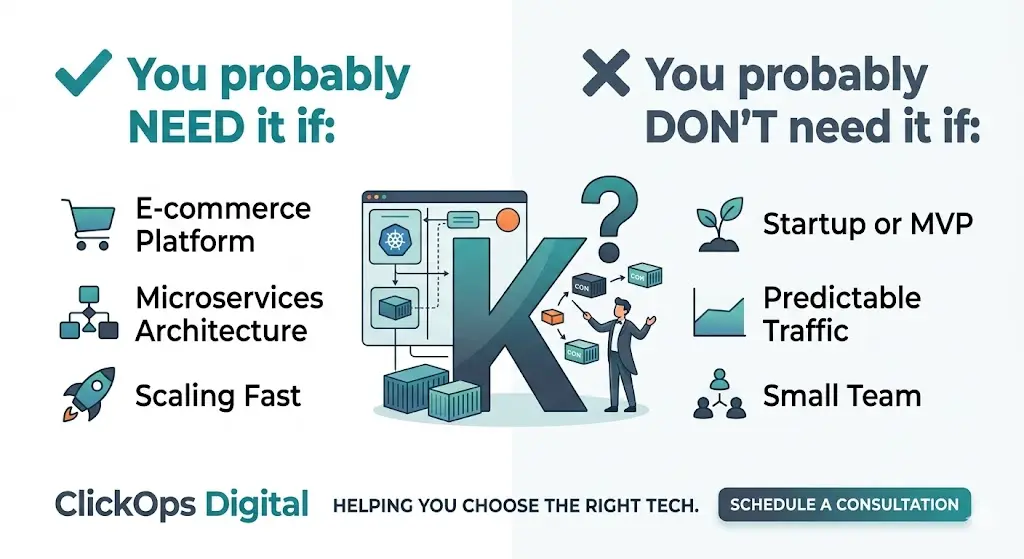
So, do you really need it?
This is where we get practical. Kubernetes is powerful, but it’s also complex and can be expensive to manage.
You probably NEED it if:
You are an E-commerce Platform: Your traffic fluctuates wildly (like during Black Friday), and you cannot afford a single minute of downtime.
You use Microservices: Your app is broken into many small, moving parts that all need to talk to each other.
You are Scaling Fast: You have a large team and need a standardized way to deploy code across different environments.
You probably DON’T need it if:
You have a Startup or MVP: You need to move fast. Setting up a complex K8s cluster might slow you down when a simple setup like AWS Fargate or DigitalOcean App Platform would work perfectly.
You have Predictable Traffic: If your traffic is steady, the “magic” of auto-scaling might not be worth the setup cost.
You have a Small Team: K8s requires maintenance. If you don’t have a dedicated DevOps person, it can become a burden.
The Bottom Line
Kubernetes is an incredible tool for managing complex, high-traffic applications. However, for many businesses, there are simpler, more cost-effective ways to get the same results.
Not sure which path is right for your project? At ClickOps Digital, we specialize in helping businesses find the perfect balance between high-tech performance and simple, manageable infrastructure.